Asia-US container rates were mixed this week as peak season fades: East Asia to US West Coast rates sat at roughly $7,475–8,300 per FEU, while the East Coast lane moved differently, according to Hellenic Shipping News. Over the same period, liquid chemical tanker rates out of the US Gulf held stable. For a chemical buyer in Thailand, Vietnam or Indonesia, the useful reading is not the number itself. It is the split between the two markets, and what a flat tanker rate does and does not tell you about getting liquid product onto a ship when you need it.
What happened to Asia-US container rates this week
The weekly freight report summarised by Hellenic Shipping News showed container rates from East Asia and China to the United States moving in different directions by coast. The West Coast range of about $7,475–8,300/FEU is the clearest data point; the East Coast did not follow it in step. That is the signature of a market losing its single direction: carriers are still defending rate levels on some lanes while softer demand shows through on others.
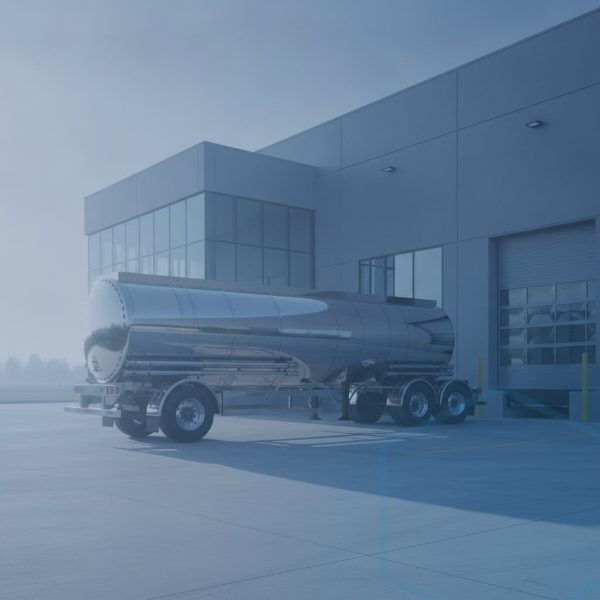
Liquid chemical tankers loading in the US Gulf — a major export base for methanol, glycols and a range of solvents — reported no meaningful change in rates over the same week. Container and tanker markets do not usually move together, and this week they did not.
DIC does not publish its own freight or product prices. The figures above are publicly reported market data, cited for context only.
Why container and tanker markets diverge
The two markets run on different commercial logic.
- Container freight is short-cycle. Much of it trades on spot or short contracts and reacts to consumer restocking. Carriers manage it actively, mainly through blank sailings — cancelling scheduled voyages to pull capacity out of a lane and protect rate levels. That is why container rates can swing within a few weeks even when underlying demand barely changes.
- Chemical tanker freight is long-cycle. A large share moves under quarterly or annual contracts between owners and major chemical producers. The specialised fleet is smaller and turns over slowly, so rates lag short-term swings in either direction.
This season, carriers worked to extend peak-season pricing by holding rate floors and restraining capacity additions, trying to avoid the oversupply that has collapsed rates in past cycles. As US importer demand cools — inventories were rebuilt early, and buyers are cautious around tariff changes — carriers are adjusting lane by lane. The result is the mixed picture reported this week.
Stable tanker rates are not the same as available tank capacity
This is the point most procurement teams in Southeast Asia should take from the week. For liquid chemicals moving in ISO-tanks, the binding constraint is rarely the freight rate. It is allocation.
Regionally, the ISO-tank fleet is controlled by a small number of operators. When global demand for bulk liquid capacity tightens, a flat rate can sit alongside a slot that is not there on the date your production plan needs it. A buyer who sources a liquid input through a single ISO-tank channel carries that allocation risk even in a quiet freight market — and a quiet market is exactly when the risk gets ignored.
How the impact differs by buyer segment
- Food and beverage manufacturers: most additives — thickeners, preservatives, acidulants — travel packed in standard containers or IBCs. Container rate movement feeds into landed cost here, though not necessarily straight into ingredient pricing.
- Personal care manufacturers: many surfactants and emollients move as bulk liquids in ISO-tanks. Stable tanker rates help on cost, but booking certainty is the real exposure.
- Pharmaceutical manufacturers: temperature control, humidity limits and traceability requirements make switching transport channels slow. Freight shifts are best tracked early, so inbound schedules are not crowded into peak windows.
- Electronics and semiconductor manufacturers: high-purity chemicals are more sensitive to delay than to freight cost. Space allocation during an extended peak season matters more than the rate itself.
Comparing chemical transport channels
| Criterion | Standard container | ISO-tank | IBC drum |
|---|---|---|---|
| Typical cargo | Packed solids, bagged powders, drummed liquids | Bulk liquids, full-tank volumes | Liquids and semi-solids, small to mid volumes |
| Rate volatility | High; seasonal and lane-specific | Lower; contract-driven | Moderate; flexible by shipment |
| Operator concentration | Many competing carriers | Concentrated; few large operators | Dispersed; many intermediaries |
| Minimum volume | Per TEU/FEU | Usually a full tank | Per drum or IBC |
| Main risk for SEA buyers | Peak-season rate swings | Slot allocation | Needs a partner with buffer stock and proper handling |
Monitoring checklist for procurement teams
- Track public container indices (SCFI, Drewry WCI) alongside trade press such as Hellenic Shipping News, rather than relying on a single carrier's quote.
- Note when your ISO-tank or tanker contracts come up for renewal; today's stable rates may not survive the renewal date.
- Ask your logistics provider directly about tank availability on the lanes you depend on, not only about rates.
- Where the material allows it, split the same input across more than one channel — container, ISO-tank and IBC — so one tight market cannot stop a production line.
- Raise buffer stock on long lead-time imports from China through the tail of peak season.
- Review whether vendor-managed inventory (VMI) can move part of the freight and lead-time risk to a supplier that holds local stock.
Frequently asked questions
Do rising Asia-US container rates raise the cost of importing chemicals into Thailand or Vietnam?
Not directly or in the same proportion. Asia-US and intra-Asia lanes (China to Thailand, Vietnam or Indonesia) have separate supply and demand. The indirect effect is capacity: when carriers shift ships toward higher-paying lanes, feeder and intra-Asia schedules can thin out, which shows up as longer or less reliable lead times more than as higher prices.
If chemical tanker rates are stable, is it a good time to book ISO-tank shipments?
Stable rates say little about availability. Because few operators control the ISO-tank fleet regionally, a slot on the date you need can be hard to secure even when rates are flat. Confirm allocation, not just price, before committing a production schedule to it.
What should we watch to anticipate freight changes for chemical imports?
Watch both markets separately. SCFI or Drewry WCI give the container picture; trade reporting on chemical tankers covers bulk liquids. They run on different cycles, so one calm market is no guide to the other.
Is an IBC drum a realistic alternative to ISO-tank for liquid chemicals?
For many liquids in small to mid volumes, yes. IBCs ship in standard containers, draw on a much wider pool of carriers, and let a buyer order by shipment rather than by full tank. The trade-off is handling: the supplier needs suitable storage and a buffer to make it work.
How DIC helps
Freight swings on international lanes are why DIC runs an IBC drum channel alongside ISO-tank sourcing for liquid chemicals. It decouples a client's supply plan from a concentrated group of tank operators, so a tight tanker market on one lane does not stall a production schedule on another. Combined with vendor-managed inventory and an isolated pharma-grade warehouse in Bangkok, it lets manufacturers in Thailand, Vietnam and Indonesia hold sensible buffer stock without carrying the freight risk themselves. If you are reassessing how your chemical logistics mix holds up under freight volatility, talk to the DIC team through the contact form.